
Why Blockchain + AI Matters for Utilities
When we talk about silos, the first instinct is to blame government. The utility department doesn’t talk to the planning department. The regulators don’t coordinate with finance. The health agencies don’t coordinate with public works.
And it’s true. Government silos are real. But here’s the uncomfortable truth: we all live in silos.
Utilities guard their data.
Engineering firms protect their bids.
Nonprofits stay in their advocacy lane.
Community groups hold their ground on local issues.
And none of this is wrong. Silos exist for good reasons:
- They allow specialization.
- They protect accountability.
- They give each group the freedom to focus on their unique perspective.
The real problem is not the silos themselves. It’s that silos don’t connect. They exist as closed boxes instead of open nodes. So when a challenge cuts across every box—flooding, climate change, carbon accountability, or a pandemic—the system collapses.
The Lesson from My Own Work
I’ve seen this up close. When I led a $8.5 billion capital program at Miami-Dade, it wasn’t the engineering of pipes and pumps that nearly broke us. It was the fractured system around them:
- Regulatory agencies working in parallel but not in sync.
- Contractors and consultants submitting data that couldn’t be reconciled.
- Communities demanding transparency without a clear line of sight into projects.
- Billions flowing through finance systems that didn’t always map to field realities.
The truth is: we had the talent, we had the funding, and we had the mandate. What we didn’t have was a unified system of trust.
That realization has stayed with me.
The Utility Pain Points
Across the sector, it’s the same story:
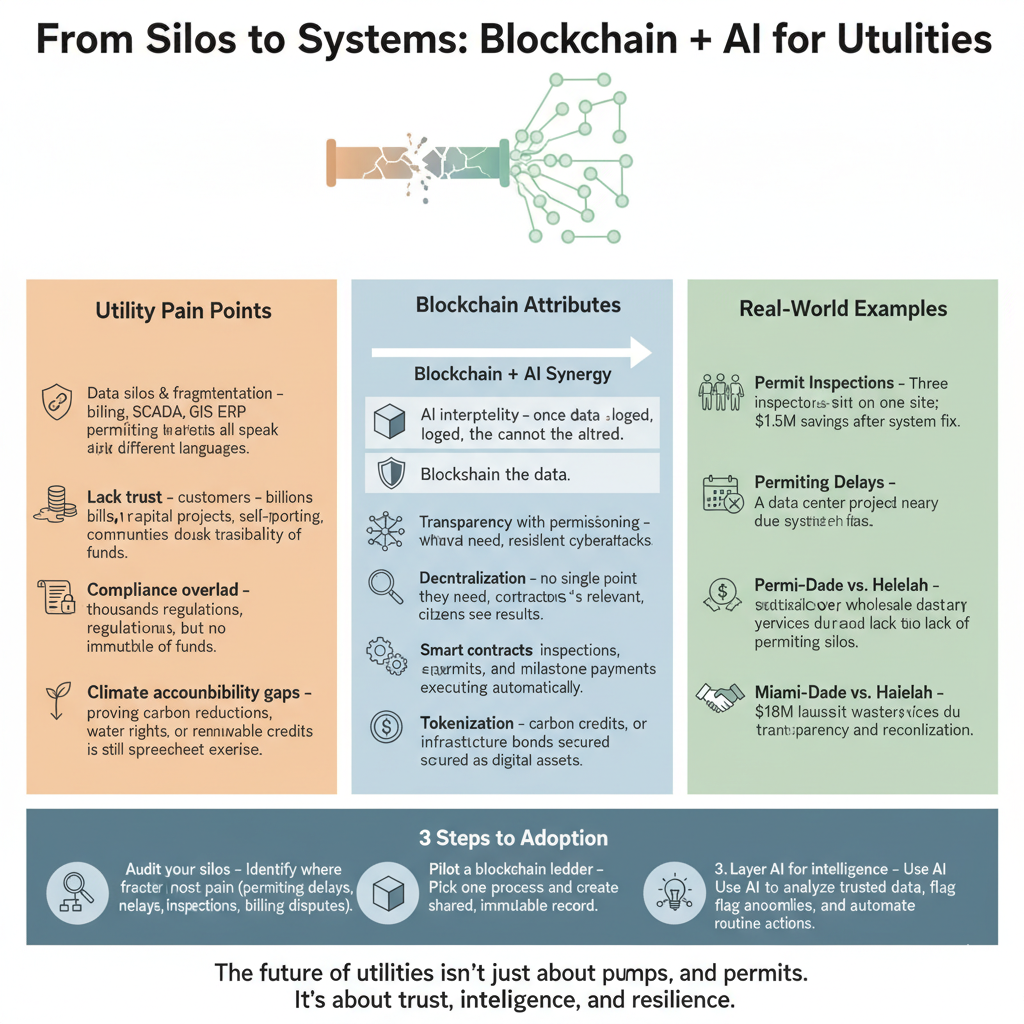
- Data silos & fragmentation – billing, SCADA, GIS, ERP, permitting all speak different languages.
- Lack of trust – customers doubt bills, regulators doubt self-reporting, communities doubt environmental data.
- Financial inefficiencies – billions in capital projects, but weak traceability of funds.
- Compliance overload – thousands of regulations, but no immutable audit trail.
- Climate accountability gaps – proving carbon reductions, water rights, or renewable credits is still a spreadsheet exercise.
A Firsthand Example: Permit Inspections Gone Wrong
About a decade ago, when I was serving in the county, I got a call from a facility manager who was beyond frustrated. Three different inspectors had shown up at their site—on the same day, at different times—all looking to conduct inspections tied to the same project.
The problem wasn’t just inefficiency. It was trust erosion.
The contractor didn’t know which inspection mattered.
The facility operator felt harassed.
And within the county, it was a case of silos within silos—departments not talking to each other, each carrying their own version of the truth.
We fixed that system at the time, and the savings were real—about $1.5 million recovered through streamlined processes and reduced duplication.
But here’s the point: that fix required manual effort, leadership, and a patchwork of process reforms. There was no single ledger of truth to prevent it from happening again.
This is exactly the kind of problem blockchain is built for.
- One immutable record of inspections.
- Shared visibility across departments.
- Automatic reconciliation, no duplication.
The savings would have been structural, not just circumstantial.
Fast Forward: Permitting Today
And yet, here we are—10 to 15 years later—and permitting systems are still notorious.
Ask any business owner, developer, or citizen what they dread most, and the answer is always the same: permitting. It’s the talk of every city, every chamber of commerce, every council meeting.
The inefficiency has become legendary. In fact, in one of the most high-profile cases in recent years, it took nearly two years to permit a data center project—a billion-dollar investment delayed not by construction challenges, but by permitting silos.
The lesson is sobering:
- We’ve patched, reformed, and digitized around the edges.
- But the systemic problem of trust, transparency, and interoperability has never been resolved.
- Permitting remains the clearest proof that silos still dominate the way we govern infrastructure.
And if we’re honest, it’s not just about inefficiency. It’s about faith in the system. When permitting takes years, people lose confidence that government is a partner in progress.
A Case Study: Miami-Dade vs. Hialeah
Recently, right here in South Florida, we saw a county and a city land in court over a $18 million dispute on wholesale sewer services.
Miami-Dade filed a lawsuit against Hialeah in July 2025, alleging the city violated its wastewater agreement and failed to pay for services delivered.
This is a symptom of deep structural failure:
- Contract records didn’t align.
- Usage data couldn’t be reconciled transparently.
- Trust between two governments broke down so badly that the courtroom became the only path forward.
If governments can’t reconcile their own utility systems, how do we expect citizens or regulators to trust them?
Now imagine instead a system built on blockchain + AI:
- The contract terms logged immutably.
- Meter data uploaded in real time to a shared ledger.
- AI flagging discrepancies immediately when consumption and billing diverge.
- Smart contracts automatically enforcing payments or triggering audits.
In that system, a $18 million lawsuit never even materializes—because the system itself enforces trust.
The Attributes of Blockchain
This is where blockchain enters—not as hype, but as infrastructure:
- Immutability – once data is logged, it cannot be altered.
- Transparency with permissioning – regulators see what they need, contractors see what’s relevant, citizens see results.
- Decentralization – no single point of failure, resilient against cyberattacks.
- Smart contracts – inspections, permits, and milestone payments executing automatically.
- Tokenization – carbon credits, water rights, or infrastructure bonds secured as digital assets.
Blockchain doesn’t erase silos—it turns them into nodes on a trusted ledger.
The silos keep their autonomy, but now they contribute to a larger system of truth.
Why AI Alone Isn’t Enough
Blockchain is a ledger of trust, not a brain.
Utilities also need intelligence:
- Leak prediction.
- Demand forecasting.
- Pump optimization.
- Anomaly detection.
That’s where AI comes in.
The Convergence: Blockchain + AI
When you bring them together, you change the operating model:
- AI interprets the data.
- Blockchain verifies the data.
- Smart contracts act on the data.
Example:
AI predicts Pump #7 will fail in two weeks.
Blockchain confirms the verified maintenance history.
A smart contract triggers a work order and payment release automatically when the job is complete.
That’s not just efficiency—that’s resilience.
The Future Signals
This isn’t far away, it’s already emerging:
- DAOs for watershed management or citizen oversight.
- Stablecoins for project finance or micro-payments for distributed energy/water services.
- NFTs as digital twins of assets—pipes, pumps, treatment plants—linked to lifecycle records.
- Utility-grade blockchains like Algorand or Minima, built for compliance, security, and scale.
So here’s the bottom line:
Silos are not the enemy. The absence of a system to connect them is the enemy.
Blockchain + AI doesn’t erase silos.
It honors their uniqueness, while weaving them into a larger fabric where communities, organizations, and governments can finally act as one system.
The question is not “Should utilities use blockchain?”
The real question is: How long can utilities afford to operate without a trusted, intelligent system of record?
If you’re a utility leader, regulator, or community stakeholder, the time to explore blockchain + AI isn’t tomorrow. It’s now.
- Start small – apply it to billing disputes, compliance records, or inspection logs.
- Build trust – use blockchain to anchor credibility, then layer AI for insight.
- Think systemic – don’t just digitize silos; connect them into a network of trust.
Because the future of utilities isn’t just about pipes, pumps, and permits. It’s about trust, intelligence, and resilience.